


As a young Bahá’í, I was exposed to the Islamic mystical tradition. I owe much to that education. To this day, 36 years after I left the Bahá’í Faith, I can still sound a bit like a self-styled Sufi. I do believe that the Bahá’í view on mysticism is authentically Islamic. I occasionally refer to passages from the Qur’án that I continue to find “inspired”:
God is the Light of the heavens and the earth;
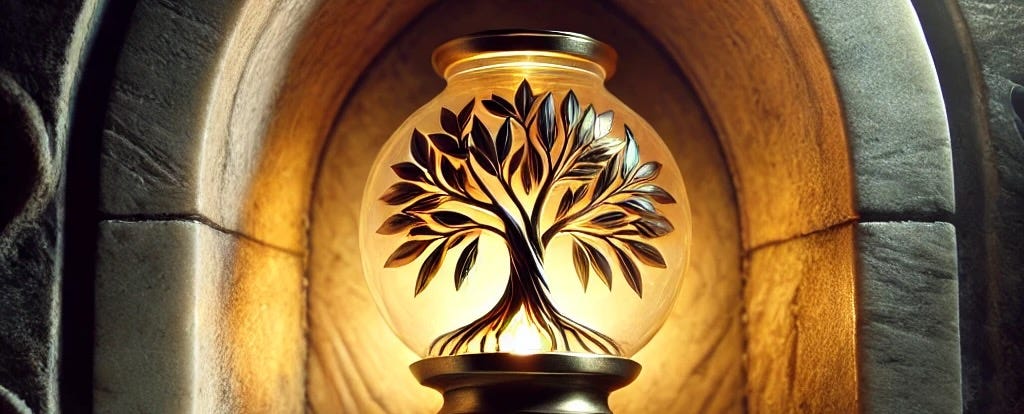
the likeness of His Light is as a niche wherein is a lamp
(the lamp in a glass, the glass as it were a glittering star)
kindled from a Blessed Tree, an olive that is neither of the East nor of the West
whose oil wellnigh would shine, even if no fire touched it;
Light upon Light; …
Qur’án 24:35 (trans. Arberry)
Hmmm … God as light. It nearly sounds … Zoroastrian!
… or Neoplatonic.
I view Islamic mysticism as a subspecies of monotheistic mysticism, that is, an effort to transcend one’s own individuality with a view toward approaching a singular Creator who exists independent of the universe.
Of course there are other kinds of mysticism. Let’s summarily excuse magical thinking from the table. Authentic Islamic mysticism is not about magic: it is about the individual’s relationship with God. This is similar to Hindu mysticism, only Hindu mysticism is not quite as bound to the Abrahamic doctrine of monotheism. Buddhism might be said to be a form of mysticism in that it strives to annihilate the self, but Buddhism is not concerned with anyone’s relationship with God (a commendable omission).
What do I have against the Abrahamic preoccupation with God? My problem with it is that if one takes the idea of monotheism seriously, one eventually comes to realize that God is none of our business. We have no business musing on the nature of God or even the unknowability of God. For the sincere monotheist, that is all blasphemy, hubris. Monotheism in its purist form is indistinguishable from atheism (not to say that there is no place for reverence, worship, or mysticism).
So I’m an ex-monotheist because I’m a sincere monotheist. I sometimes find myself sounding like an Isma`ilí Muslim, reciting:
Whithersoever you turn, there is the Face of God.
Qur’án 2:115 (trans. Arberry)

But really, when it comes right down to it, I have no business opining on the countenance of God.
The Mazdean (Zoroastrian) question is not “what is God?,” but rather “what is Good?” For instance, a Bahá’í might tell you:
God is unknowable in His essence …
[yet] we are created to know God and to worship Him.
A Mazdean may or may not find that statement paradoxical, but I think an informed Mazdean might respond that —
The Good is unknowable in its essence,
yet we strive to know the Good, to worship It, and to strive for It.
My own preferred species of mysticism has a Mazdean flavor: to strive to transcend one’s own circumstances and prejudices to gain knowledge of what is good so that one can better oneself and better one’s world. This is not a secularization of mysticism: it is a religious enterprise, for it relies on a faith in transcendent goodness and is concerned with what is worthy of reverence.
In contrast, isn’t the very notion of reverence a rather miserable thing if it lacks a dimension of goodness or beauty? What is worship of the Almighty other than power worship?
All that said, it is not inappropriate to ask: what does a Mazdean mystic look like?
Well, she might look a bit like a Muslim mystic who contemplates matters and discusses issues with his peers, though the Mazdean’s issues would relate to ethics, and even aesthetics. She may even meditate as an eastern mystic does, perhaps to break down her conscious barriers between goodness and beauty. Chiefly, the Mazdean mystic will be distinct in that her meditations, investigations, and conversations must always incorporate a dimension of action, not because anyone says so, but because her mysticism is focused on morality.