

In our preceding dispatch, we met my ancestor Francis Quenet. We concluded with his arrival as a boy in Manhattan ca. 1797. Regrettably, that account was little more than a stream of begats and locations. I just don’t know much about that story. It was a long time ago. In this dispatch, we meet my grandmother Jennie MacNeil, someone that I actually knew personally.
The Barra MacNeils of Iona
Jennie’s people had immigrated from the Isle of Barra, west of Scotland. Three of her grandparents were Barra MacNeils; the forth was a Uist MacDonald.
Jennie was born in the rural Barra Glen neighborhood of Iona, Nova Scotia. Seven of Jennie’s direct ancestors, including her parents, grandparents, and one great-grandmother, were born within a four-mile radius of Iona.
Iona was every bit as authentically Scottish as any place in Scotland, and perhaps it still is: it is the location of the Highland Village, the world’s premiere Highlander cultural center — excluding Scotland.
What made Iona so authentic? The Highland Clearances. As communities and local economies were actively dismantled in the old country, Scottish immigrants in Canada were able to maintain a level of community and self-sufficiency that could no longer be sustained in Scotland. After a century in Canada, the MacNeils still spoke Gaelic at home (though Canada had been suppressing the language since 1850).
Boston and New York
Jennie came to Boston from Nova Scotia in April 1919.1 She was 18 at the time. An eldest daughter, she’d had troubles at home and fled south for opportunities in the Yankee south. A year later, Jennie was working as a domestic servant in a home on Moreland Avenue in Newton, just west of Boston, and Babe Ruth had left Boston for New York.
By 1922, Jennie had moved to New York City. One thing that genetics revealed long after Jennie had died was that she had a relationship with a Jewish immigrant from Warsaw, Poland named Louis Spector. When he’d emigrated, Warsaw had been in the Russian Empire. That was not an easy time for Poles, whether Jewish or otherwise. I don’t know the details of the his relationship with Jennie, that is, whether it was true love, a one-night stand, or even consensual. One interesting fact is that Louis’ father died of a brain hemorrhage when Jennie was 4 months pregnant. One can imagine a stroke coming on after a man is told that his son has got a gentile girl pregnant, but without resorting to such drama one can imagine that the sudden death of a father could render a young man unstable.
A complicating detail: Louis’ father died a week after Jennie married my grandfather: how long had Mr. Spector lived after his hemorrhage?
Louis Spector went on to marry, but some time after the birth of his fourth child (not including Jennie’s pregnancy), Louis abandoned his family. This occurred during the depth of the Great Depression: Louis was one of many fathers to do so, so I’m not sure that this is grounds to cast judgment. Louis died in Miami in his mid-50s.
To reiterate, though DNA has linked Jennie and Louis together permanently, we will probably never know whether their relationship was a Shakespearean tragedy or a mere incident.
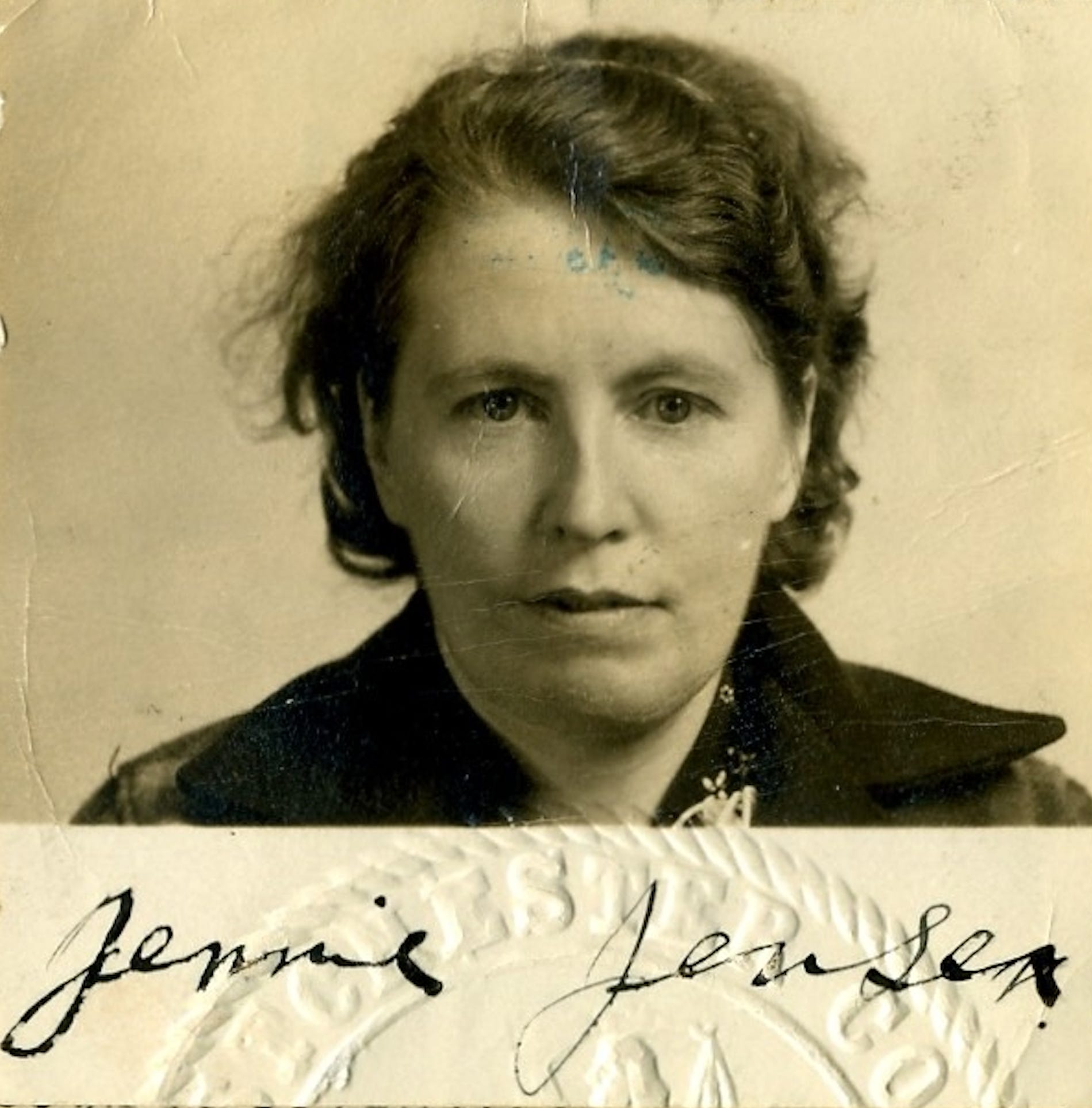
The Church and the Border Patrol
Jennie married my grandfather Rasmus Jensen after four months of pregnancy. Jennie and Rasmus went on to have two children who didn’t resemble each other. Jennie was a Catholic and Rasmus was a Lutheran. This was a problem so far as Jennie’s father and the parish priest were concerned. Looking back, we can see that Jennie probably had little choice, having been desperately pregnant at the time of the marriage. Border records show that she returned to Nova Scotia to visit her family in 1925 and 1929. Her attempts to make peace with her father failed, and she was excommunicated from the Catholic Church for marrying a Protestant. By 1929, the United States had introduced border controls. Jennie was undocumented, so she and her two children were detained at the border, but they were ultimately allowed through. She never visited her parents again. The Church ultimately “re-communicated” her.
I said that I knew Jennie personally, but as things look now, not as well as I thought. I did talk to her about her life and her family in Nova Scotia back when I was 13, and I took notes, but I knew so little and there was little that I could think to ask. Of course, I would like another chance to chat with her today, but would I have the nerve to ask the hard question?
… or else.
According to a US border crossing record and the 1920 US Census for Newton, Massachusetts.