

For many years now, I’ve felt a strong kinship with Zoroastrianism, and for a number of reasons. I even consider myself a Zoroastrian, but only in a very broad sense. I do not live by the specific laws and practices of the religion as it has evolved over the millennia. My perspective is more that of a modern person who feels that he has walked the path that Zarathuštra walked some three thousand years ago. Not to flatter myself: I simply believe that the core of Zarathuštra’s religion is timeless and that any one of us can find deep truth in it.
So what is that timeless core?
The first and most central aspect of Zarathuštra’s religion is a very simple, straightforward realization that we live in a moral universe; not a universe of moral laws, but a universe of deep, profound value that cannot be codified. It is beautiful, yet it is cruel. There is one thing for sure: it is not indifferent. It matters.
Zarathuštra proclaims as much in his hymns, the Gathas:
Yes, there are two fundamental spirits, twins are renowned to be in conflict.
In thought and in word, in action, they are two: the good and the bad.
And between these two, the beneficent have correctly chosen, not the maleficent.
Gathas (Yasna 30:3)
This is the classic, definitive scriptural passage on Zoroastrian dualism. It is important to notice that the good and bad spirits (whatever “spirit” might be taken to mean) are twins, which I take to mean that they are not necessarily distinguishable from each other at first glance, but they are very much opposites.
The celestial power who represents the good twin in Zoroastrianism is Ahura Mazda (“Wise Lord”), not to say that Mazda is the good twin. The use of the term Mazda (“Wisdom”) is significant, as much as good thinking is emphasized in Zarathuštra’s hymns.
It is important to note the triad of thought, word, and action in the above passage. This is reminiscent of the formula that nearly serves as the Zoroastrian creed: “good thoughts, good words, good actions.” These three domains of moral agency are bridged implicitly by yet another theme of Zoroastrian thought: integrity.
Also note the word choose in the above passage and again in the passage below.
Choice is a fundamental aspect of Zoroastrian thought and an implicit link between thought and action. These latter two are not unrelated to words, that is expression, the second element of the existential triad. Words are of course a form of action and alternatively a linkage between thought and action.
Continuing with the theme of choice:
The gods did not at all choose correctly between [right and wrong]
Gathas (Yasna 30:6)
But ye gods — as well as the one who worships you — all of you
are the offspring stemming from evil thinking, deceit, and disrespect.
Gathas (Yasna 32:3)
Because Zarathuštra found the gods (devas) to be misguided, he arose to oppose them. If there is any religion that is about speaking truth to power, it is the religion of Zarathuštra, however Zoroastrianism is not intrinsically against power per se. It has of course served as the state religion of empire, and Zarathuštra repeatedly supplicated Ahura Mazda and whatever gods he found to be worthy for assistance, because he himself was powerless. The distinction in Zoroastrianism is that gods are not worthy of supplication simply because they are gods. Worthiness of worship is a key concept in Zoroastrianism.
The principle of Aša (pron. Asha) is almost as lofty as Mazda in Zoroastrianism. Aša represents truth and order. The opposite of Aša is Druj, meaning deceit (or the Lie), which is associated with disorder. Zarathuštra names his eternal hell the House of Deceit.
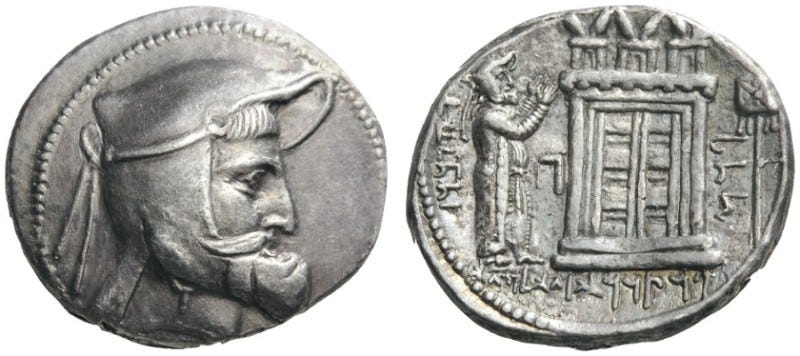
Aša is symbolized by fire. Fire has long been used in sacrificial ceremonies as a means to transmit offerings to the gods, as the smoke and heat of burned offerings rise to heaven. Fire is thus a universal messenger to the gods. In the case of Aša, fire may be used as a symbol because of its ability to purify metal, or rather, to reveal the true constituents of a substance, that is to say the truth of things. It may also be that fire signifies light because of the obvious association between light and truth.
Fire is repeatedly associated with truth in the Gathas, and as a representation of truth is an object of worship, for instance:
To his question, “whom dost thou wish to serve?” I then replied:
“Thy fire. As long as I shall be able, I shall respect that truth is to have a gift of reverence.”
Gathas (Yasna 43:9)
This passage appears to say, “I worship fire because I worship truth.”
Fearing the wrathful hegemony of Abrahamic monotheists, some may strive to defend Zoroastrianism by asserting that Zoroastrians do not worship fire. To that I would reply that all worship is idolatry, whether it is worship of physical objects or of mental objects. I happen to find that latter form of idolatry — what might be called idealatry — to be the more hazardous form.
Fire is a profound and dynamic phenomenon that has played a critical role in human evolution. It is in its way a primitive form of life. For these and other reasons, fire warrants worship more than any naive notion of benign omnipotence.
Life is regarded as essentially virtuous in Zoroastrianism. Death, in contrast, is regarded as bad, and associated with disorder. Traditionally, corpses are thought to contaminate the elements, particularly fire and water. Hence cremation and even burial have traditionally been avoided by Zoroastrians.
In summary, Zoroastrianism is an ancient faith that reveres goodness, specifically the goodness of truth and order, integrity, and life. Zoroastrianism regards the Good as something that must be chosen. Choice is essential, or rather existential.
Note and Disclaimer: Translations by Stanley Insler (1975). Whenever providing passages from the Gathas (the most ancient Zoroastrian hymns), one must bear in mind that we cannot be certain of our translations. The Old Avestan language died long ago, and all translations amount to guesswork, though studies of Sanskrit have taught us much about Old Avestan. In practical terms, if a translation corresponds in some reasonable way to traditional Zoroastrianism, it is perhaps trustworthy enough.