

I’ve loved the work of Vincent Van Gogh, if in this case memory doesn’t deceive, since I first saw his The Church at Auvers in an entry of my illustrated Arabic dictionary, back in 1986. The blue of the sky is so dark that it almost seems to forebode something terrible, or wonderful …
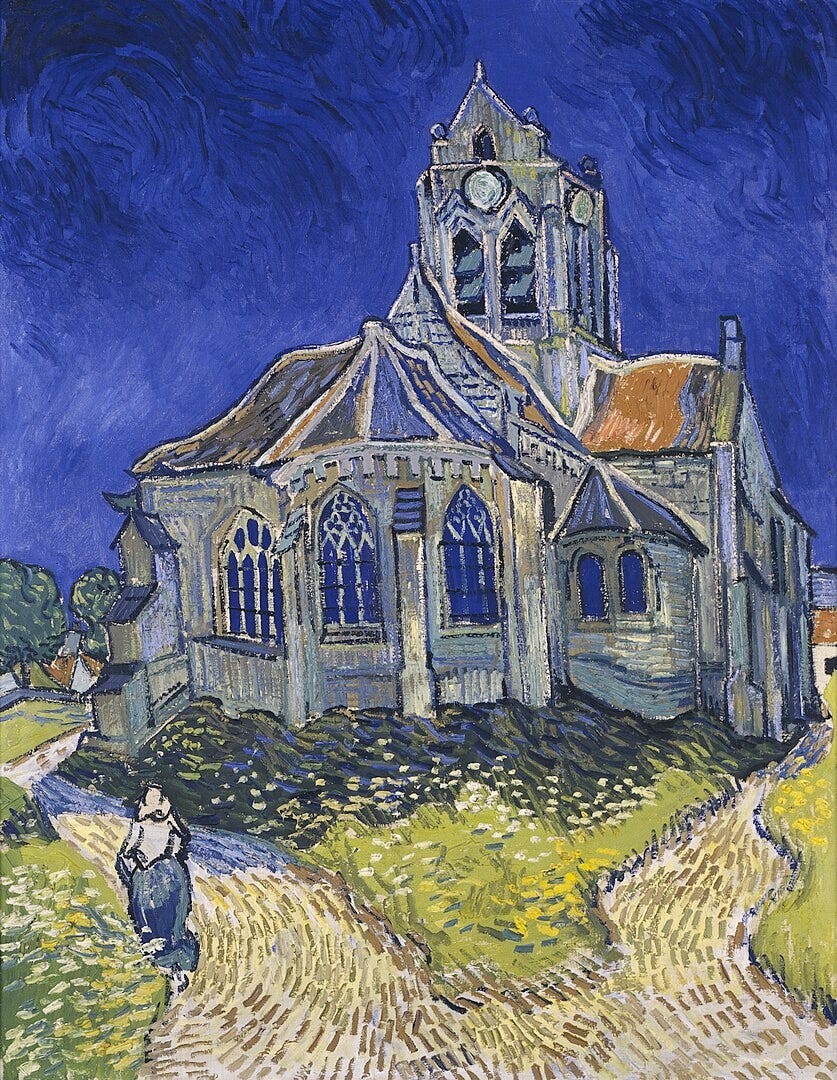
The ground is bright, except where the church casts a shadow. The shadow — a literal foreshadowing — is cast in our direction; it covers the church as though it is of the church. The dark sky can be seen through windows of the church. The church seems to throb, or simmer — as though it were seen through the convecting air above hot asphalt, an oasis of sorts. Looking at it, I do not feel threatened, rather I feel fascinated, wrapt, as though I am watching the substance of reality revealed as it burns through its façade. It is not holy or demonic, or rather, it is both. There is a spontaneous naiveté to the vision that makes me feel that this is what the artist sees; not physically, but personally.
I’m not proud to admit that I’m not a big fan of the art of painting. I do admire the craft and the intelligence that goes into it, but paintings don’t generally make my eyes well up as music, poetry, and cinema can. I see this as a weakness, a personal shortcoming. I think that perhaps vision is too intellectual a sense. Van Gogh is an exception, possibly the single exception.
The Church at Auvers was painted near the end of Vincent’s life, maybe within a month. It is not the only painting of that moment that embodies such a duality of light and darkness. A later work, Wheatfield with Crows, reveals an earth that glows gold as it were a sunflower, or the sun itself, while the sky — like the sky above the church — is dark blue. If it is a night sky then it is starless. This sky is different, though. The black and blue are separating like oil and water …
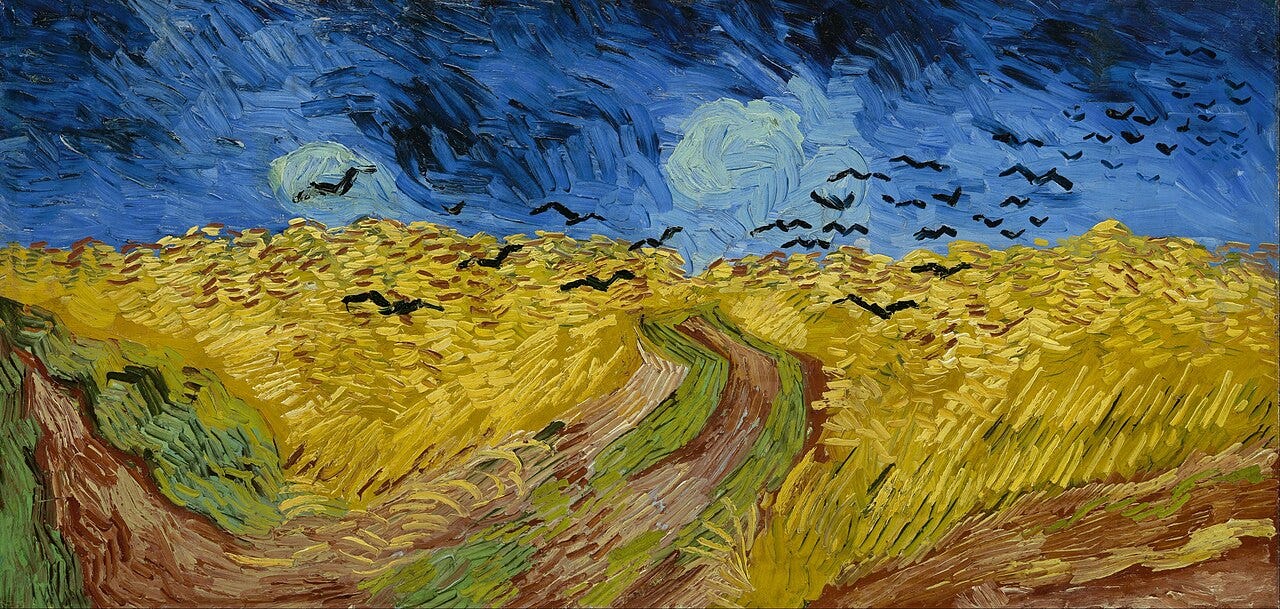
There is no church here, but instead a murder of crows. The crows, not unlike the church, seem to break through the surface. Perhaps they foreshadow death, or maybe freedom. They seem to emerge from the blackness of the immiscible sky. They, unlike the church, do not cast shadows. It is reported that Vincent used a pistol to set these crows to flight, and it is likewise reported that he used that same pistol, a little later, to set the crows of his heart to flight.