

I was a Bahá’í child of 13 at the moment of the Iranian Revolution. I had been raised on stories of martyrdom and persecution of Bahá’ís in what we called “the Cradle of the Faith.” Some of the gruesome bedtime stories were quite entertaining. There was that martyr Mulla Husayn — if memory serves, slicing through a tree and a soldier in one swing. Most of it was not so cinematic. Since those primal battles against the Shah’s troops, persecution of the Bahá’ís had long persisted in Iran, but with the rise of the Ayatollahs it got worse. It got worse for a lot of Iranians, but the Bahá’ís were singled out as always, but moreso now because public opinion in the Middle East had turned against Israel. The Islamist regime called the Bahá’ís Zionists without good reason, simply because the governing institution of the Bahá’í Faith was located in Israel. That was a ridiculous charge because the Bahá’ís had been in Palestine long before there was an Israel.

But it is interesting to reflect upon what the arrival of the Bahá’ís in Palestine did to change the vision of that Iranian religion. As the Bahá’ís dwelt upon their new circumstances, they began to associate their move to Palestine with Biblical prophecies of the end-times, and thus when European Jews began to displace the indigenous people of Palestine, Bahá’ís began to see “the return of Israel” as fulfillment of prophecy. To this day, Israel means a lot to Bahá’ís. True, Bahá’ís are strictly non-political and they have no control over Bibi or the Knesset, so they cannot be blamed for the many crimes of Israel against humanity, but man do they love Israel.
Hypothetically, what if a faith that is based in Israel were to maintain a single-minded political campaign against the Islamic Republic of Iran? What if that faith exhibited no interest in the persecution of any other people in any country whatsoever? What if that same faith was utterly silent about the persecution, ethnic cleansing, and mass-murder of Palestinian peoples by Israel and America, yet were continually writing their congressmen about the misdeeds of Iran? That would be quite a coincidence, no? What would we expect an Ayatollah to make of it?
Here’s a typical call-to-action addressed to the Bahá’ís of the United States:
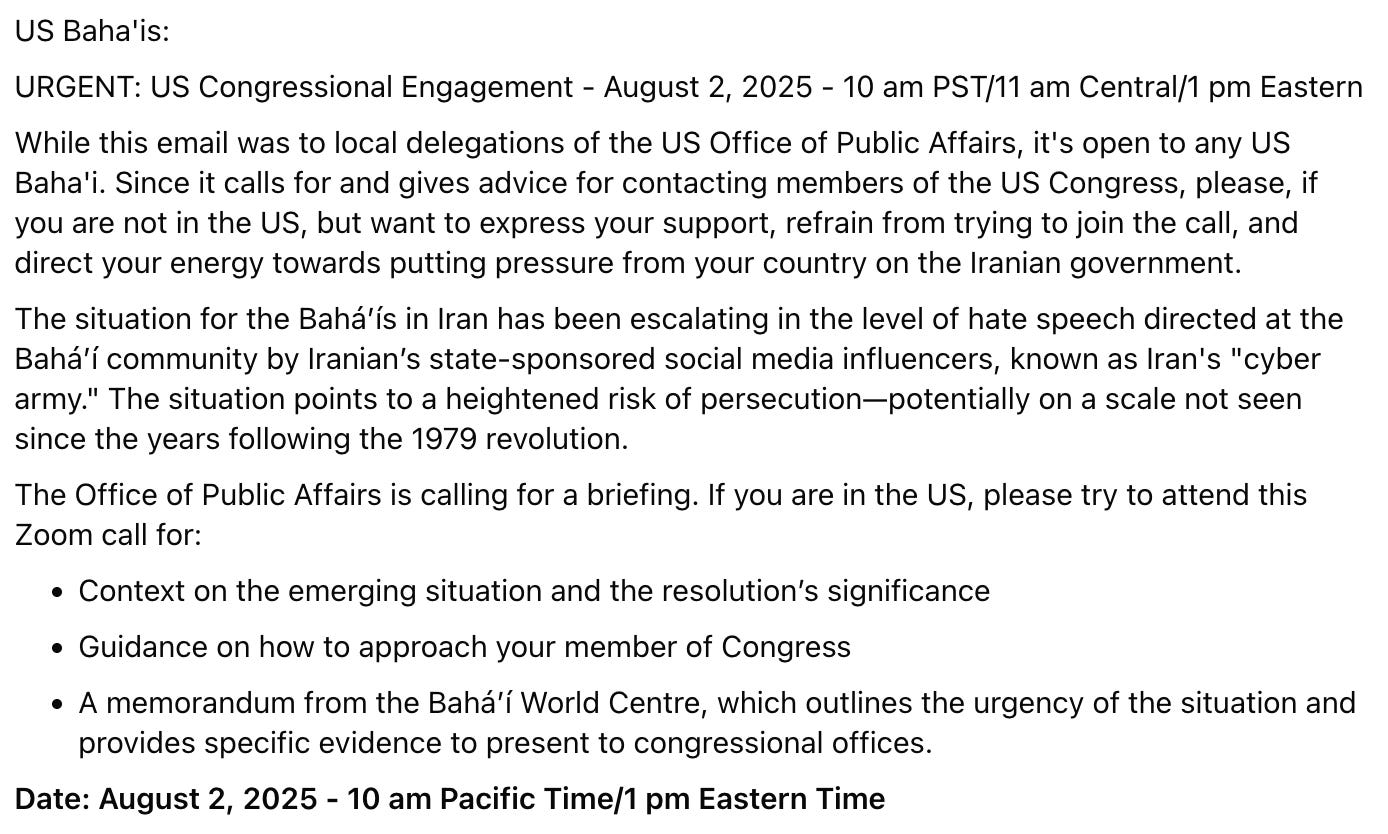
I can tell you that I was a teenage Zionist. I was raised by my parents, my society, and my scriptures to be a Zionist. I was an “apolitical” Zionist, but let me assure you, Israel could do no wrong by me, and I was no outlier among Bahá’ís; nay, I represented the great majority of American Bahá’ís. And at the same time, I was repeatedly called by my leaders to pressure Congress to scold the Iranian government.
… As if Congress, ever the faithful servant of Israel, needed the Bahá’ís’ help in leveling pronouncements against Iran.
It all started with a silly coincidence, it’s true, but then I suppose doesn’t everything?